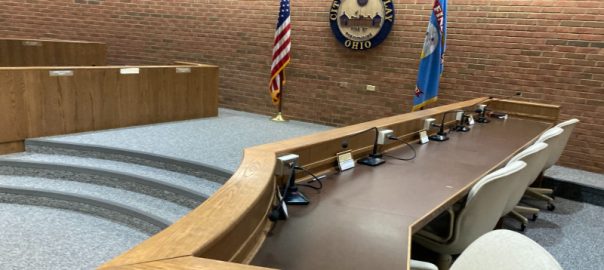
Findlay City Council voted down a proposed loitering ordinance at its Tuesday night meeting.
Several community members have pushed back against the ordinance since it was proposed, saying it threatens the freedom of people to exist in public spaces without fear of being criminalized.
The city said it has received increased complaints regarding loitering in and around parts of downtown, loitering that often includes signs of drug use and other criminal acts.
The city said the intention of the ordinance was to have some control and enforcement of such conduct which currently does not exist in city code.
Below is audio of how the vote went, the text of the ordinance, and video from Tuesday night’s city council meeting.
ORDINANCE NO. 2025-134
AN ORDINANCE ENACTING REGULATIONS ON UNLAWFUL CONGREGATION.
BE IT ORDAINED by the Council for the City of Findlay, Ohio:
WHEREAS, Council for the City of Findlay desires to prohibit lingering in a public place
for an extended period of time without apparent purpose with the intent to deter more
serious criminal acts.
SECTION 1. That effective immediately upon adoption of this Ordinance, the new
regulations on unlawful congregation as attached hereto shall be active and enforced.
SECTION 2: This Ordinance shall be in full force and effect from and after the earliest
period provided by law.
Section 1. Purpose
The purpose of this ordinance is to promote public safety and order by prohibiting conduct that
obstructs public ways or facilitates criminal activity, while preserving the constitutional rights of
individuals to move freely, assemble, and engage in lawful activity.
Section 2. Definitions
For purposes of this ordinance:
- “Loiter” means to remain in a public place without apparent lawful purpose after being
requested by a law enforcement officer to move along, when such conduct obstructs
pedestrian or vehicular traffic or interferes with lawful business on the premises.
- “Public place” means any street, sidewalk, alley, parking lot, or area open to the
general public.
- “Obstruct” means to intentionally or recklessly block, hinder, or impede the free
passage of pedestrians or vehicles.
Section 3. Prohibited Conduct
(A) No person shall intentionally or recklessly:
- Obstruct the free passage of any other person or vehicle on any public way, sidewalk, or
public place; or
- Remain in a public place after being lawfully ordered by a law enforcement officer to
move, when the officer has observed that the person’s conduct:
(a) Is causing or contributing to an obstruction; or
(b) Is reasonably associated with the commission, attempted commission, or
solicitation of a specific unlawful act including but not limited to; prostitution, drug
trafficking, or assault.
(B) No person shall be stopped or ordered to move solely for standing, walking, talking, or
otherwise engaging in lawful behavior in a public place.
Section 4. Law Enforcement Procedures
- Before issuing an order to disperse or move along, a law enforcement officer shall:
– Identify themselves and explain the specific conduct observed that constitutes an
obstruction or indicates intent to engage in a specific unlawful act.
- The person shall be given a reasonable opportunity to comply before any arrest or
citation is made.
- Officers shall document the specific conduct and circumstances leading to the
enforcement action.
Section 5. Penalty
Violation of this ordinance is a minor misdemeanor.
Section 6. Severability
If any portion of this ordinance is held unconstitutional or invalid, the remaining portions shall
remain in full force and effect.